

A legislative constituency averages 80,000 to 120,000 registered voters. It can be a city centre and its suburbs, but also a rural territory stretching across several dozen square kilometres, encompassing dozens of communes, hundreds of hamlets, thousands of streets that no campaign team will ever be able to cover entirely. Door-to-door canvassing everywhere is impossible. Spreading your activists across such a territory amounts to doing nothing effectively.
The swing polls & streets method addresses precisely this constraint: concentrating precision work where it can change the result, and nowhere else.
A two-step method
The logic is straightforward. In any constituency, electoral data by polling district allows two types of areas to be identified: those where one political current dominates clearly, and those where everything is at stake, where two or three currents (sometimes four or five in proportional democracies) share the vote without any one clearly winning. These contested areas are what we call swing polls.
What defines a swing poll is the absence of a clear dominant force and a vote distribution tight enough that targeted canvassing can make the difference. In France in the 2020s, this is often a three-bloc configuration. In Switzerland or Belgium, these are neighbourhoods where four or five parties each score between 10 and 20%. The partisan geography changes by country and era; the principle remains identical.
Once these areas are identified, we zoom down to street and building level to locate the pockets of voters most favourable to the candidate commissioning the analysis. These are the swing streets: the precise streets and buildings where to concentrate leafleting, letterbox drops and door-to-door canvassing for maximum activist return.
The gain is considerable. In the 5th constituency of Morbihan (Lorient, Ploemeur, Lanester, Larmor-Plage), 82,000 registered voters in total, applying the method reduced the useful analysis zone to 23,000 voters: those residing in genuinely contested areas. It is on these 23,000 voters, and only them, that the entirety of the fine-grained targeting work is conducted.
The neighbourhood effect: an often underestimated multiplier
Concentrating door-to-door canvassing in neighbourhoods rarely worked by opposing teams produces an effect well documented in academic literature. The neighbourhood effect refers to the tendency for residents of the same residential area to vote similarly, the process involving social contacts between neighbours that generate political exchanges and information flows influencing electoral behaviour (Wolfe, 1978; Johnston et al., 2004). An activist who rings a doorbell is not only speaking to the voter who answers: they inject a message into a proximity network that will relay it, discuss it, sometimes validate it.
This mechanism extends beyond the contacted household. Experimental research on the contagion effects of canvassing shows that the message passed to one member of a household spreads to uncontacted household members, leading to a systematic underestimate of the real impact of ground campaigns (Nickerson, 2006). In a building or street where no team has been for months, a well-targeted activist presence gets people talking, positively.
The 5th constituency of Morbihan (Brittany, France): one concrete example
In the 2024 legislative elections, the 5th constituency of Morbihan offered an exemplary configuration: in the second round, Damien Girard (Union de Gauche, 38.9%), Lysiane Métayer (Ensemble, 34.2%) and Aurélie Le Goff (Rassemblement National, 27%) were separated by less than twelve points. Every vote counted.
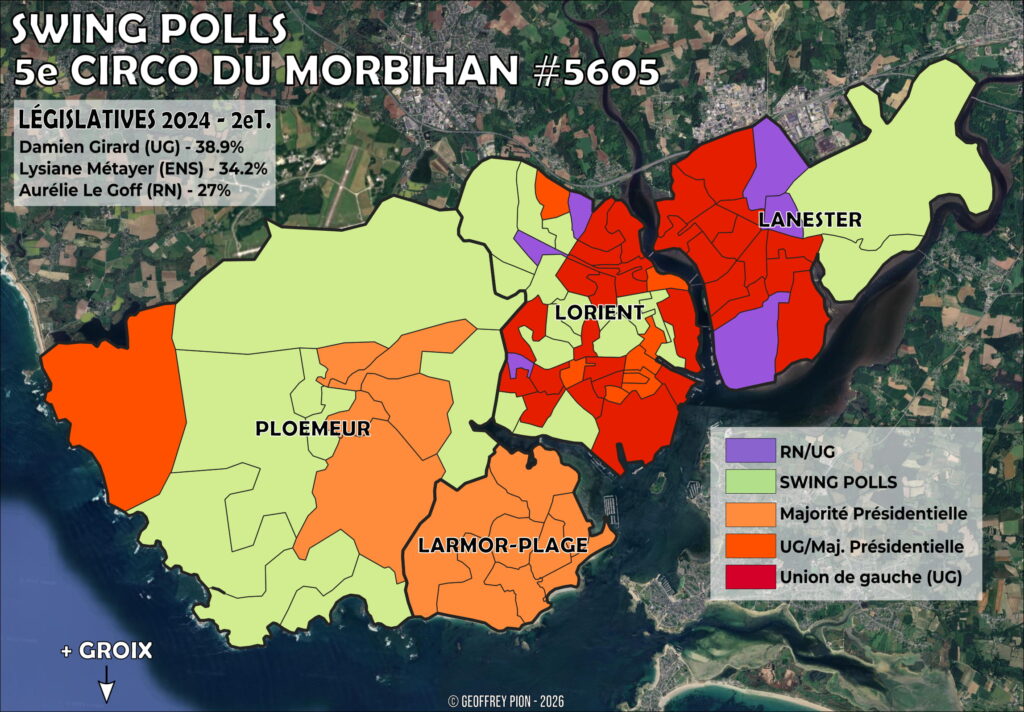
The swing polls map identifies across the entire constituency the areas where no current dominates. In light green, around thirty polling districts in Lorient, Ploemeur and Lanester, where the three blocs are neck and neck. Larmor-Plage has none: its electorate is too homogeneous for precision work to be useful there. The rest of the map, in red, orange and purple, shows strongholds settled in one direction or another: areas to leave aside in order to concentrate resources where they can actually weigh.
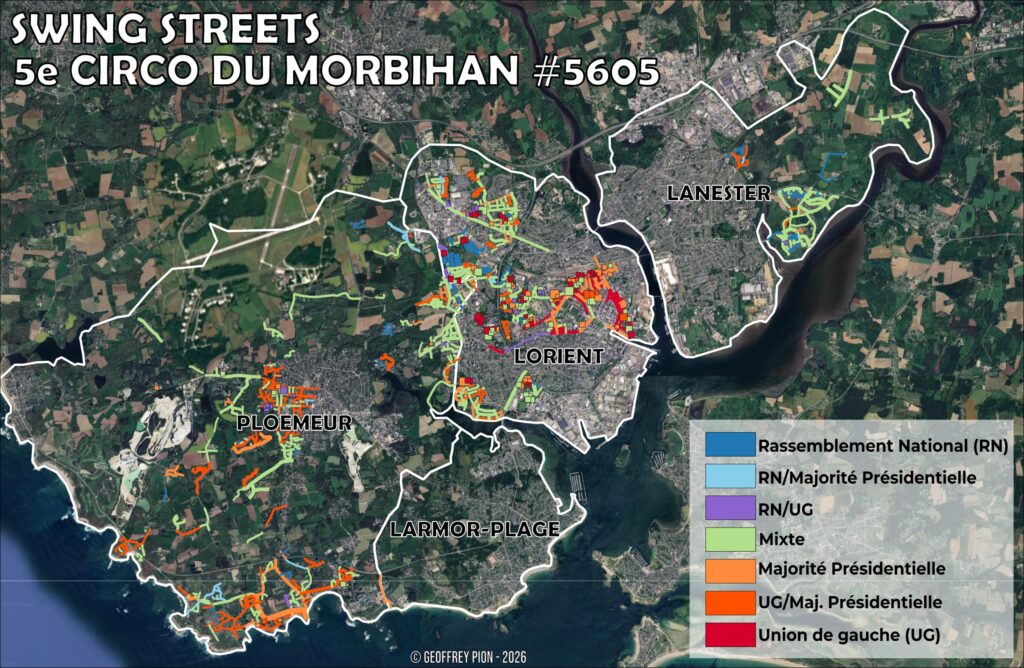
The swing streets map is the result of the descent to street and building level, conducted exclusively within these contested areas. What this map reveals is often counter-intuitive. Areas that appear globally balanced at polling district level contain in reality very sharply defined structures: in the northern and western neighbourhoods of Lorient, RN-dominant streets (in dark blue) sit alongside Union de Gauche-dominant streets (in red) sometimes separated by just a few dozen metres. In Ploemeur, the majority-presidential streets and estates (in orange) form dense clusters in the town centre and coastal neighbourhoods. In Lanester, the two swing poll districts reveal exceptionally pronounced electoral mixing, with numerous light green streets where the three blocs are level at building scale. Everywhere, the polling district average was masking these contrasts. The swing streets map reveals them, and turns them into an operational roadmap.
From this point, four targeting products can be built for any political current present in the constituency.
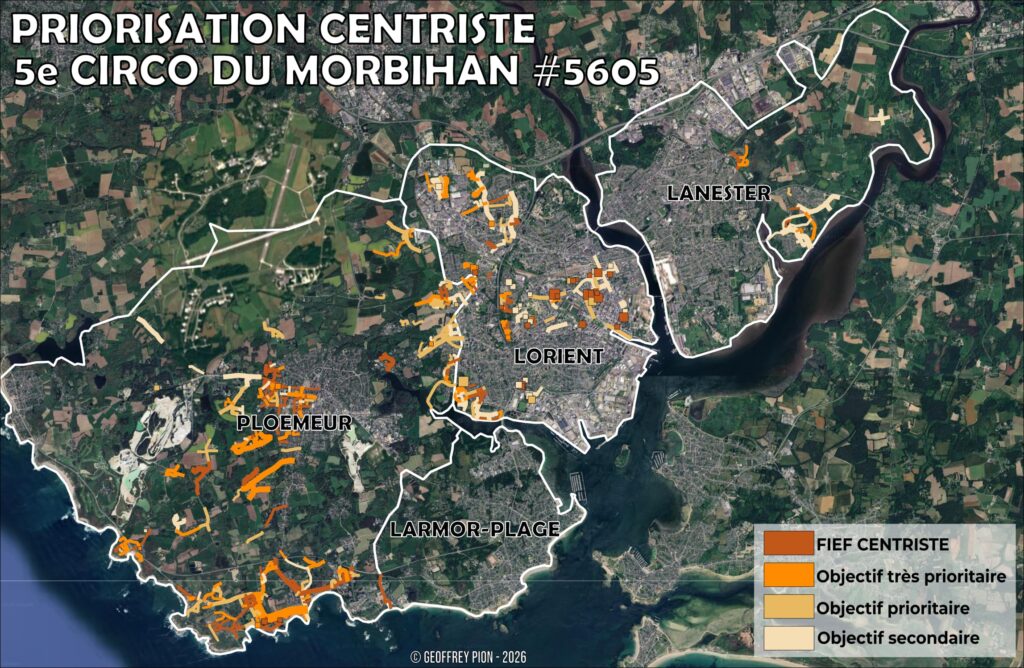
The prioritisation ranks the 600 streets and buildings of the swing polls into four levels. In dark brown, the strongholds of the targeted current: areas already won where canvassing gains nothing. In bright orange, the top priority target (between the most favourable 12.5% and 25%): the streets to cover absolutely in the last week of the campaign. Then a priority target and a secondary target, to be planned according to the number of activists available. A handful of activists or a few dozen will not cover the same perimeters: it is up to the candidate to decide based on their resources and timeline.
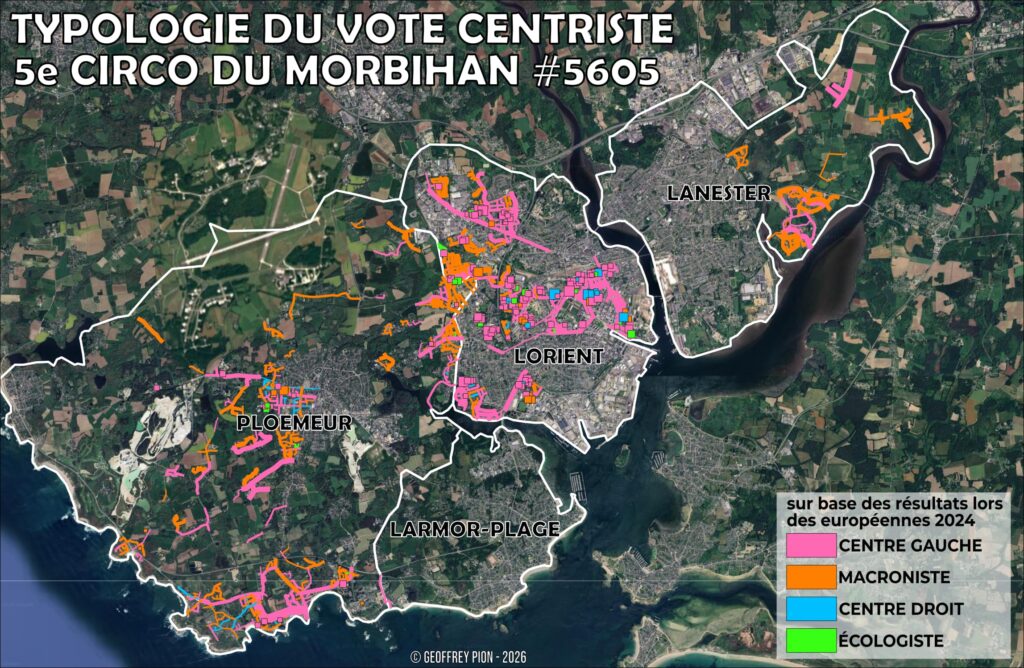
The centrist vote typology refines the analysis by distinguishing, street by street, the dominant sensitivity among the targeted current’s voters: centre-left (in pink), macronist (in orange), centre-right (in blue), ecologist (in green). Based here on the 2024 European election results, it allows a candidate to adapt their door-to-door pitch before even ringing the first doorbell. A centre-left dominant building and a centre-right dominant estate are not approached with the same message.
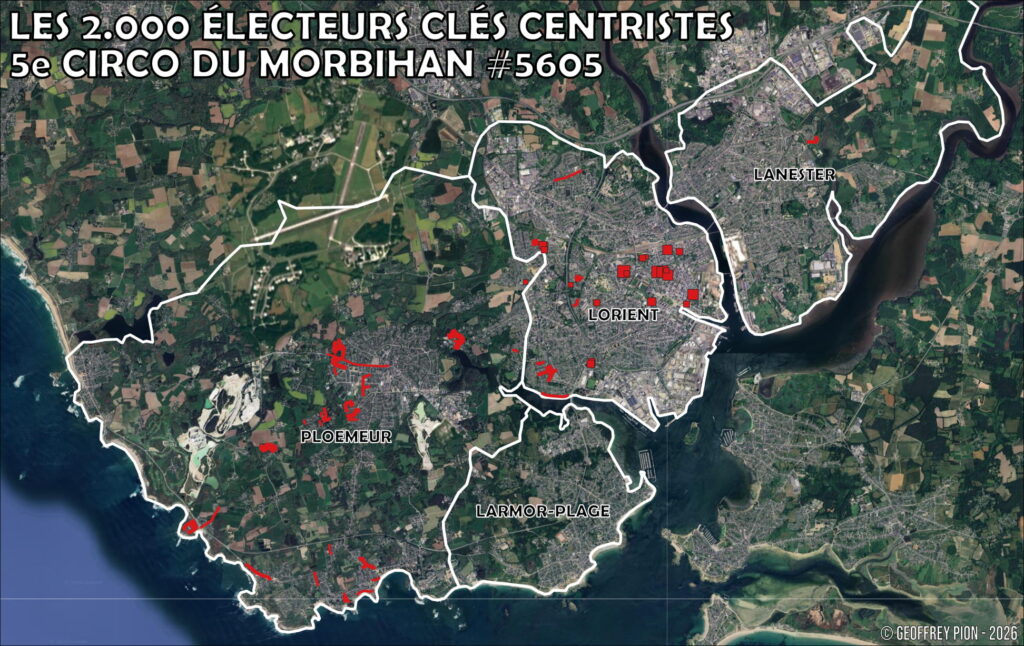
The 2,000 key voters identify the streets and buildings concentrating the highest density of favourable voters, up to a total of 2,000 people: what a team can realistically meet door-to-door over two weeks of intensive campaigning. Many streets in Ploemeur (town centre and seafront) and numerous buildings in central Lorient stand out. This is the product for the final weeks before polling day, when direct contact has the greatest chance of translating into a vote.
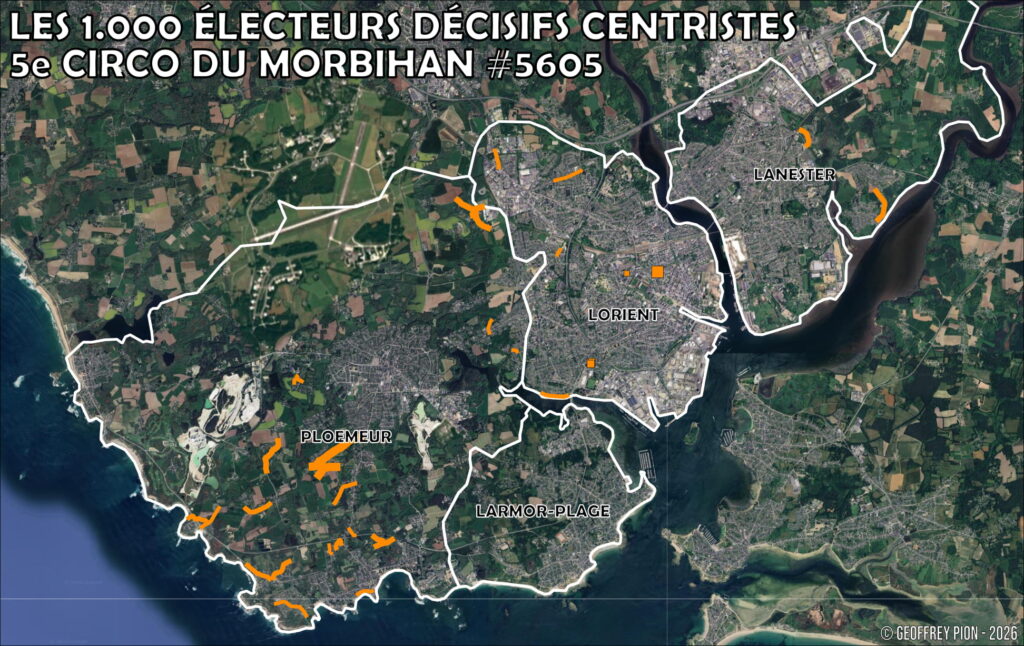
The 1,000 decisive voters push the logic to its maximum for the between-rounds period. In France, between the first and second round of a legislative election, only one week remains. In 2027, legislative elections will follow the presidential election barely six weeks later, in a context of maximum mobilisation where every hour on the ground will count double. This product designates the forty or so streets and buildings, concentrated notably in the peripheral estates of Ploemeur and the cul-de-sacs and residences of western Lorient, where very high turnout and very high favourable vote potential converge: the addresses to cover absolutely when time is running short.
Wherever you are in the world — let’s talk
The swing polls & streets method is operational on any territory where an election is contested at a scale too large for exhaustive treatment: French legislative elections 2027, departmental elections 2028, regional elections, and any large-territory election anywhere in the world. It is adaptable to any partisan landscape, any geography, any scale. Candidates who have mapped their swing streets before the campaign opens will have a head start their opponents cannot make up in three weeks of leafleting.
Electoral geographies are never the same twice. A constituency in Finland, a federal district in Mexico, an electorate in Australia or a municipal ward in Greece each has its own partisan landscape, its own territorial logic, its own data constraints. The swing polls & streets method is not a French recipe to be applied unchanged elsewhere — it is a framework designed to be adapted, questioned and rebuilt from the ground up with local knowledge.
If you are a candidate, a campaign manager or a political organisation anywhere in the world and you are curious about how this approach could work in your country, your territory, your specific context, I would genuinely love to hear from you. I am not here to lecture anyone on how things are done in France. I am here to explore, to learn from new electoral geographies, and to think through how precision targeting can be built from whatever data and constraints exist locally. I travel easily and am always looking for new electoral territories to discover.
Get in touch : info@geoffreypion.com — or directly on WhatsApp
Read more
→ FAQ n°2 – Voter Targeting in Election Campaigns
→ FAQ n°3 – Organising Effective Door-to-Door Canvassing
→ FAQ n°4 – Mobilising Non-Voters
electoralgeomarketing #electoraltargeting #swingpolls #swingstreets #canvassing #electoralcampaign #electoralgeography #electoralmapping #electiondata #campaignstrategy #groundgame #doorknocking #elections #politicalcampaign