

FAQ n°4 — Mobilising Non-Voters in Election Campaigns
Voter abstention has become the dominant electoral force in most democracies. In some local elections, turnout drops below 50% of registered voters — and lower still among young people, working-class communities and residents of disadvantaged neighbourhoods (quartiers populaires, achterstandswijken, benachteiligte Stadtteile). This FAQ answers the 7 essential questions for understanding the geography of abstention, identifying low-turnout polling stations (precincts, wards, stembureaus, Wahlbezirke), and building an effective voter remobilisation strategy — whether you are preparing for local, regional or national elections anywhere in the world.
What Is Voter Abstention and Why Has It Become So Widespread?
Voter abstention refers to registered voters choosing not to cast a ballot. Across Western democracies, it has grown dramatically since the 1980s. In France, abstention in municipal elections rose from around 25% in the 1980s to over 55% in the second round of the 2020 municipales — a historic level. Belgium stands as a partial exception with its compulsory voting system, although real abstention (non-participation plus blank and spoiled ballots) is also rising. In Quebec, municipal turnout fluctuates between 45% and 55%. Switzerland records some of the lowest turnout rates in the Western world, often below 45% for federal votes, though this structural weakness is partly offset by the frequency of referendums. In the United Kingdom, local council elections regularly see turnout below 35%. In India, turnout varies dramatically between states and between general and local elections. In the Netherlands, gemeenteraadsverkiezingen turnout has declined steadily over decades. The French political scientists Céline Braconnier and Jean-Yves Dormagen analysed this phenomenon in their landmark 2007 work La démocratie de l’abstention (Gallimard), which remains one of the most rigorous sociological analyses of this transformation of the relationship to voting in democratic countries. In the English-speaking world, Mark Franklin’s Voter Turnout and the Dynamics of Electoral Competition in Established Democracies Since 1945 (2004) provides a complementary cross-national perspective.
Where Are the Non-Voters in My Municipality?
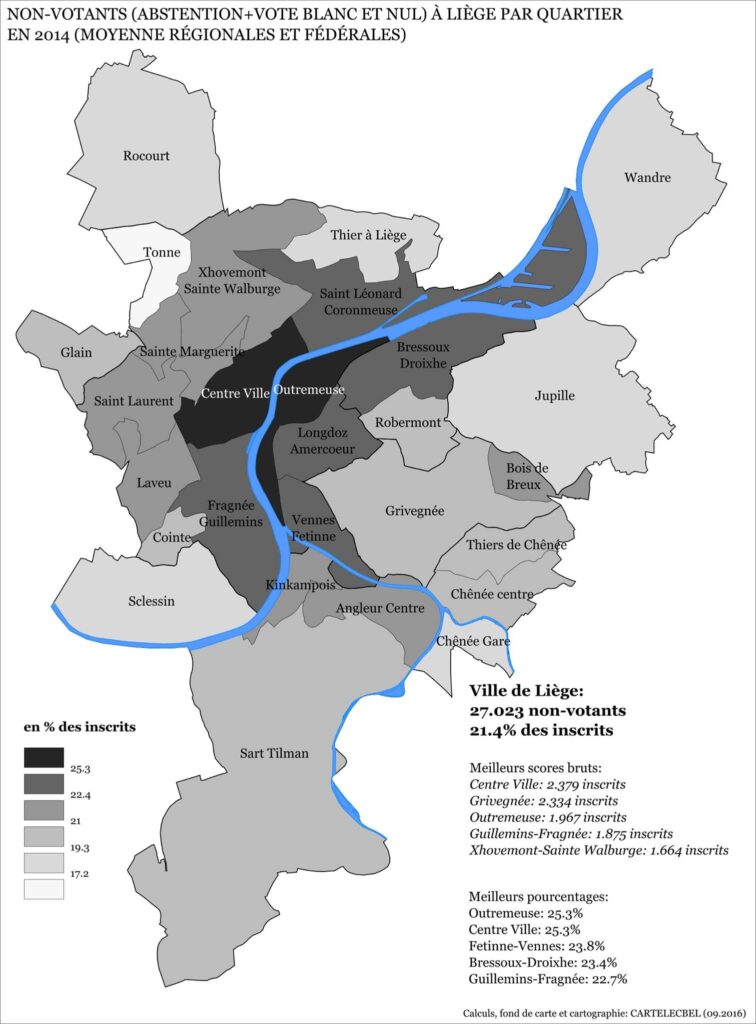
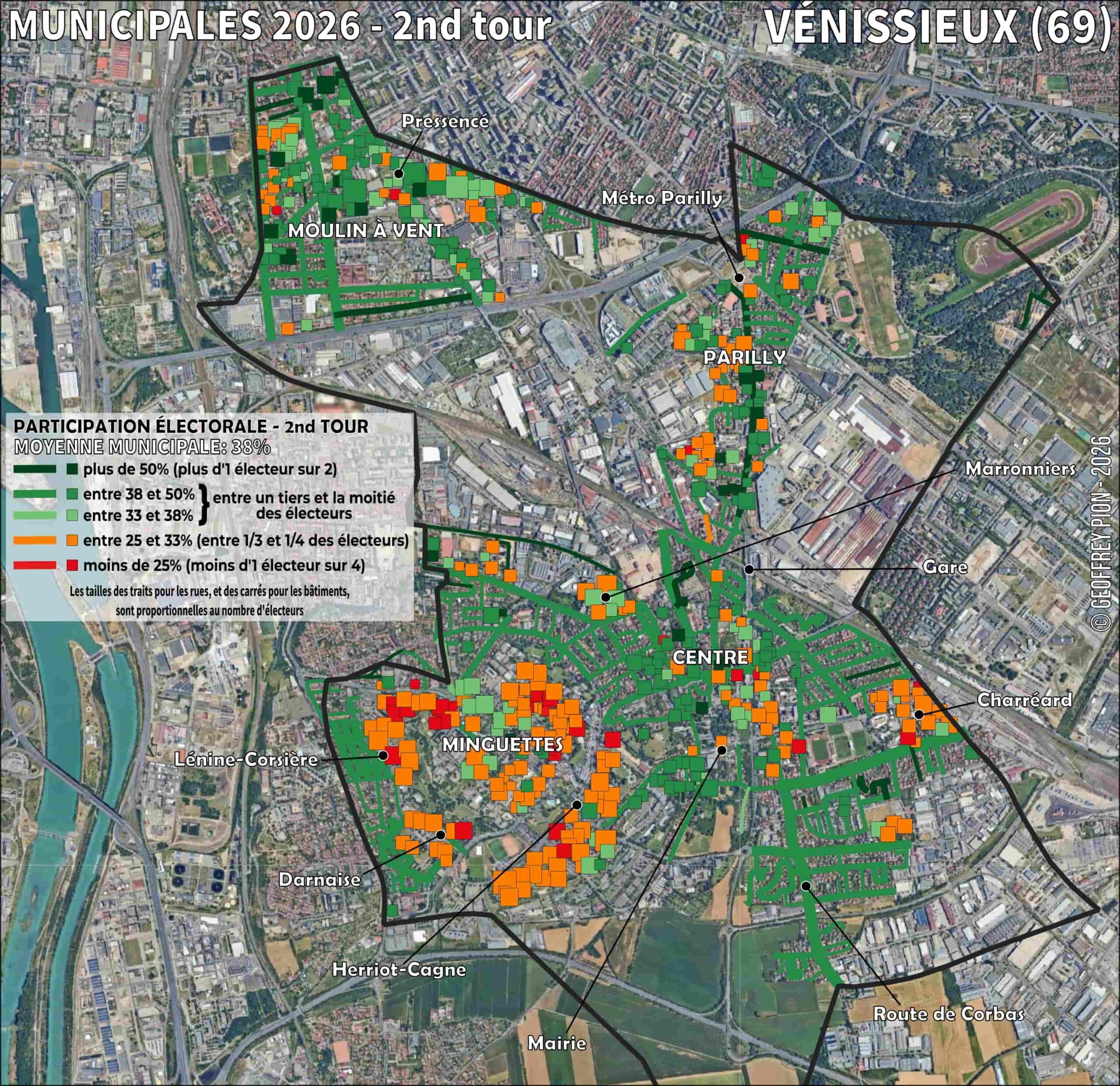
Non-voters are not evenly distributed across a municipality: they are massively concentrated in specific polling stations, and their geography is remarkably stable from one election to the next. Three territorial profiles emerge systematically. Social housing estates and public housing neighbourhoods (grands ensembles, council estates, sociale woningen, Plattenbauten, viviendas de protección oficial): abstention rates often 15 to 25 points above the municipal average, with records exceeding 70% in local elections. This profile is found in Vénissieux (France), Seine-Saint-Denis, Molenbeek and Brussels-City (Belgium), Montréal-Nord (Quebec), Tower Hamlets (London), Bijlmer (Amsterdam), and equivalent areas in every major city. Degraded inner-city working-class neighbourhoods: typically 10 to 20 points above average. Student neighbourhoods: also high abstention, but for different reasons (registration at a former address, residential mobility). Conversely, affluent residential areas and historic bourgeois centres vote heavily. A polling-station map with a turnout layer immediately reveals this geography of abstention, which constitutes the raw material for any remobilisation strategy.
How Do I Identify Low-Turnout Polling Stations in My Municipality?
Identifying low-turnout polling stations is methodologically straightforward: calculate the turnout rate (voters/registered) for each polling station at the previous election, and rank them. The operational rule: any polling station whose turnout is more than 10 points below the municipal average constitutes a priority remobilisation target. In France, the data is available on data.gouv.fr; in Belgium on elections.fgov.be; in Quebec from Élections Québec; in Switzerland from the cantonal chancelleries; in Luxembourg on elections.public.lu; in the Netherlands from the Kiesraad; in Germany from the Landeswahlleiter; in the United Kingdom from local authority websites; in India from the Election Commission; in Australia from the AEC; in Greece from the Ministry of the Interior. Once these polling stations are identified, cross-reference with two additional criteria: the demographic weight of the precinct (a polling station with 1,500 registered voters at 40% turnout represents 900 potential non-voters; one with 400 registered voters at the same rate represents only 240), and the political potential for your candidacy (a non-voter is not a neutral voter: their sociological profile determines their probable vote if they turn out). This combined analysis produces the list of precincts to prioritise.
What Is « Mis-Registration » and How Can It Be Used in a Campaign?
Mis-registration (mal-inscription) is a massive phenomenon in France, identified and quantified by Céline Braconnier, Jean-Yves Dormagen and Vincent Pons in a study published in 2017 in the American Political Science Review. Approximately 7% of French citizens are not registered on any electoral roll, and around 20% are mis-registered — meaning they are registered at a former address. This population, representing nearly one adult in four, is de facto excluded from voting because they would need to travel to a distant municipality to cast their ballot. Mis-registered voters are predominantly young, less educated, residentially mobile, and statistically more left-leaning than average. For a candidate in a municipality with high demographic turnover (large cities, student neighbourhoods, working-class areas with high residential mobility), identifying and remobilising this population can represent several percentage points on election day. The approach consists of identifying profiles likely to be mis-registered (recent arrivals, 18-30 year olds) and assisting them with a re-registration procedure at their current address. Similar issues exist in varying forms across most democracies: in the United Kingdom, the shift to Individual Electoral Registration has left millions unregistered; in the United States, voter registration barriers are a central political issue; in Belgium, Quebec and Switzerland, specific mechanisms address the problem differently.
How Do I Concretely Mobilise Non-Voters?
Remobilising non-voters is the cheapest and most powerful electoral strategy when well targeted. Five levers have scientifically documented effectiveness. First lever: targeted door-to-door canvassing (porte-à-porte, huis-aan-huis, Haustürwahlkampf, doorstep campaigning) — the only method that has experimentally demonstrated a significant mobilisation capacity (Gerber-Green 2000 in the United States, Pons 2018 in France). Second lever: voter registration and re-registration drives, particularly effective in neighbourhoods with high residential mobility. Third lever: proximity messaging, carried by volunteers from the neighbourhood rather than outsiders parachuted in. Fourth lever: clarifying the local stakes — non-voters are more willing to turn out when they perceive a concrete issue for their neighbourhood (schools, transport, safety, public services). Fifth lever: pre-election day reminders by SMS, phone call or doorstep visit, which increase turnout by 1 to 3 points according to studies. These five levers combined can swing a local election, particularly in tight multi-candidate runoffs where a few hundred mobilised votes in the right precincts make the difference.
What Are the Limits of Non-Voter Remobilisation?
Remobilisation has three limits that must be understood to avoid overestimating its effects. First limit: structural abstention is hard to convert. Chronic non-voters who have not cast a ballot in 10 or 15 years represent a highly resistant core. The priority reservoir is intermittent non-voters — those who vote in presidential or general elections but not in local ones, or who voted 5 years ago but not since. Second limit: political abstention. A portion of non-voting is a conscious political choice (rejection of the partisan offer), which is harder to overcome through technique alone. Third limit: the backfire effect. Mobilising non-voters in a neighbourhood that is politically hostile to your candidacy can produce the opposite result: increasing turnout for your opponents. Hence the importance of fine-grained spatial targeting: mobilise in the neighbourhoods where your political family has a sociological advantage, not in those where your opponents dominate. This is exactly what a polling-station map cross-referenced with socio-demographic variables produces: it distinguishes low-turnout precincts that are favourable from those that are unfavourable, and directs the remobilisation strategy towards the former.
Electoral Geomarketing: Take Action
Are you a candidate in an upcoming election anywhere in the world, and do you want to integrate non-voter remobilisation into your campaign strategy? Here are some key electoral milestones where mobilising low-turnout precincts can make the difference:
Country | Election | Year
France | Presidential & Legislative | 2027
Latvia | Legislative | 2026
Belgium | Federal & Regional | 2029
Quebec | Provincial (general) | 2026
Quebec | Federal (Canada) | 2029
New Zealand | Legislative | 2026
Taiwan | Local | 2026
Australia | Federal | 2028
Greece | Legislative | 2027
Germany | Legislative | 2029
India | Federal | 2028
Spain | General | 2027
Sweden | General | 2026
Finland | Legislative | 2027
Italy | Municipal | 2026
Malaysia | Federal | 2028
Read more
→ Electoral Geomarketing: Definition, Methodology and Strategic Applications
→ FAQ n°3 — Organising Effective Door-to-Door Canvassing
→ FAQ n°5 — Using Past Election Results to Prepare Your Next Campaign
VoterTurnout #MobilisingNonVoters #Abstention #VoterRemobilisation #ElectoralGeomarketing #DoorToDoorCanvassing #VoterRegistration #PollingStationAnalysis #CampaignStrategy #PoliticalMarketing #France #Belgium #Quebec #Netherlands #Germany #UK #India #Greece #Australia #Switzerland