

FAQ n°3 — Organising Effective Door-to-Door Canvassing in an Election Campaign
Door-to-door canvassing (porte-à-porte, huis-aan-huis, Haustürwahlkampf, doorstep campaigning) is, scientifically, the most effective campaign channel in the world — ahead of leaflets, emails and phone calls. This FAQ answers the 7 essential questions for organising canvassing that delivers results: choosing the right streets, calibrating volunteer teams, understanding the tools available across Europe and North America, and moving from random coverage to targeted door-knocking that transforms a campaign — whether you are preparing for local, regional or national elections anywhere in the world.
Is Door-to-Door Canvassing Really Effective in Election Campaigns?
Yes, and this is now a scientific certainty, not a campaigner’s hunch. The landmark study by Alan Gerber and Donald Green, published in 2000 in the American Political Science Review, experimentally demonstrated in the United States that door-to-door canvassing increases voter turnout by approximately 8 to 13 percentage points per person contacted, whereas personalised mail produces only a 2.5-point effect and phone calls have virtually no impact. In France, the major study by Vincent Pons (Harvard Business School), published in 2018 in the American Economic Review, analysed François Hollande’s 2012 campaign: 80,000 volunteers knocked on 5 million doors, which accounted for a quarter of the victory margin in the second round. More remarkably, 20% of voters who had intended to vote for the Front National changed their mind after a visit, and the effect persisted two years later. The European meta-analysis by Bhatti and co-authors (2016) confirms the effect, slightly more modest than in the United States (0.78 points on average) but present in every country studied. Door-to-door canvassing is not one method among many: it is the method.
How Do I Choose Which Streets to Prioritise for Canvassing?
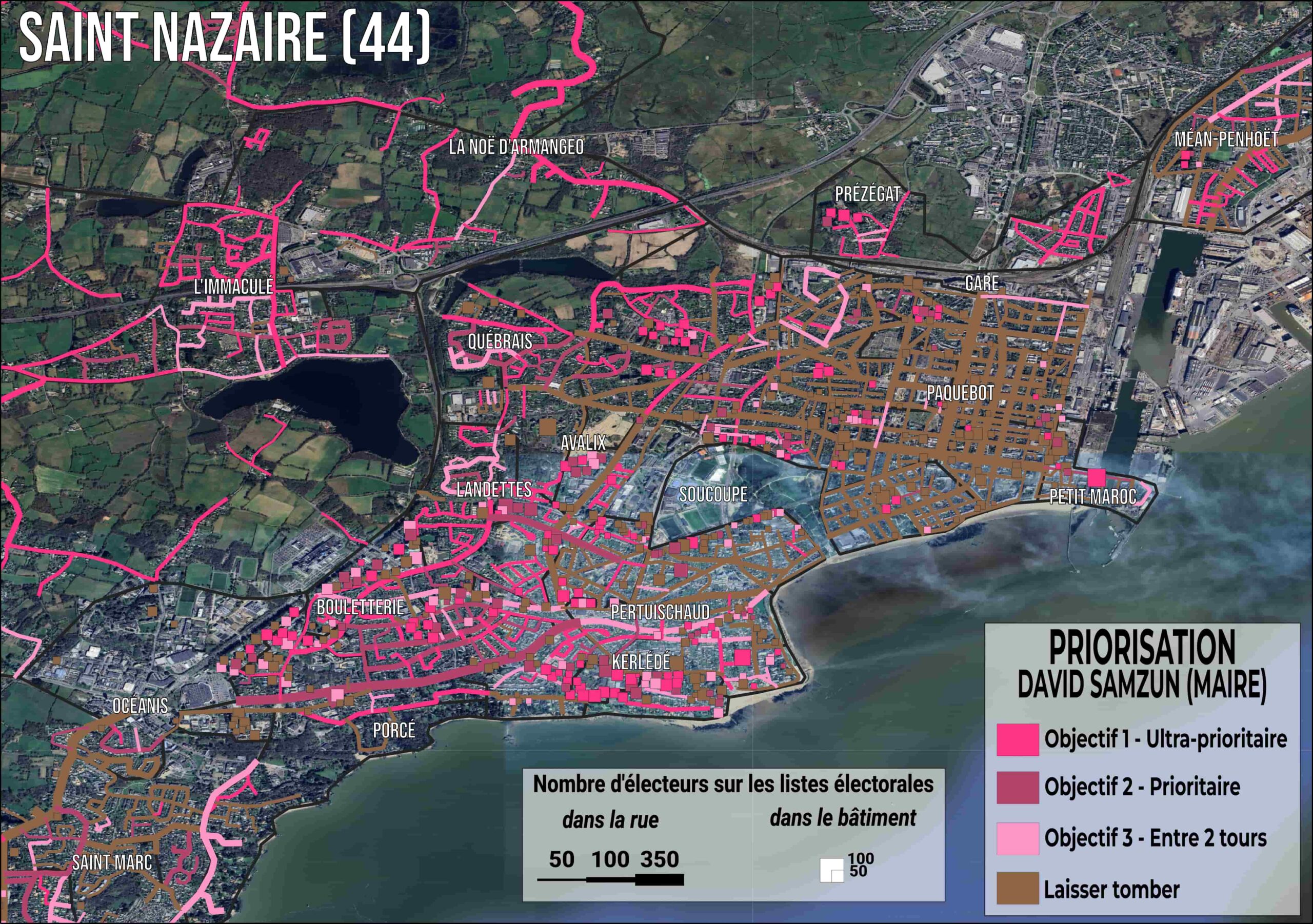
Choosing which streets to prioritise is the central challenge of effective canvassing, and it is precisely what separates a professional campaign from random volunteer coverage. The logic is the same regardless of the country: canvassing must be concentrated on high-stakes streets, meaning those where the cost-benefit ratio is highest. Three criteria combine. First, the electoral potential of the street: number of dwellings, voter density, housing type. Second, the probability of tipping: streets located in polling stations (precincts, wards, stembureaus, Wahlbezirke) where the gap between candidates at the previous election was less than 10 points take priority over streets in strongholds or lost-cause zones. Third, accessibility: a street of apartment blocks with intercoms does not yield the same return as a street of suburban houses (lotissement, verkaveling, Siedlung, semi-detached housing). A street-and-building-level map, produced through fine-grained spatial modelling, immediately ranks these priorities. In Liège, Geneva, Montreal, Bordeaux, Amsterdam, Athens, Mumbai or Melbourne, the logic is identical: canvass the right streets rather than all streets.
What Software Tools Exist for Organising Door-to-Door Canvassing?
The market for election campaign tools is dominated by a handful of key players. In France, several solutions coexist: Qomon (a French CRM specialised in politics, widely used for presidential, municipal and legislative campaigns, offering polling-station-level mapping, volunteer management and a canvassing app) and NationBuilder (the American market leader, present in France since 2012, an integrated platform combining website, CRM and field operations, used by 8 candidates in the 2017 French presidential election). In the United Kingdom, tools like Ecanvasser and Campaign Lab serve similar functions. In the United States, the market is structured around three players: NGP VAN (the undisputed leader on the Democratic side, with its national Voter Activation Network database, used by Obama in 2008 and 2012, Hillary Clinton and Joe Biden), i360 (the leader on the Republican side, with 1,800 data points on 270 million Americans), and Catalist (a specialist in progressive voter databases and predictive modelling, used by the DNC and progressive organisations). In Belgium, Quebec, Switzerland, the Netherlands, Germany and most other European countries, the market remains embryonic, with a few local solutions and occasional use of French or American tools.
What Are the Limitations of Current Canvassing Software?
All these tools share a common and structural limitation: they target at the polling station (precinct, ward) level, or produce complex grid-based overlays that are very difficult to use in the field. Yet within a single polling station, one often finds terraced houses (maisons mitoyennes, rijwoningen, Reihenhäuser), suburban detached housing (lotissements pavillonnaires, verkavelingen, Einfamilienhaussiedlungen), apartment blocks, and social housing estates (barres HLM, council estates, sociale woningen, Plattenbauten) — alongside both young and ageing populations. The internal electoral geography of a polling station can be more contrasted than the differences between polling stations, especially in countries like France where some municipalities deliberately smooth out polling-station boundaries to mask voting patterns. Activist CRMs like Qomon or NationBuilder, and voter databases like NGP VAN or i360, do not descend to this scale. In the United States, tools like Catalist attempt to model individual voter scores, but using massive behavioural databases that raise serious ethical and legal concerns (GDPR in Europe, equivalent regulations elsewhere). What I offer is unique: a zoom to the street and building level, within each polling station, at the scale best suited to ground-level campaigning, while remaining strictly compliant with Western ethical and legal standards.
How Many Volunteers Do I Need for Effective Canvassing?
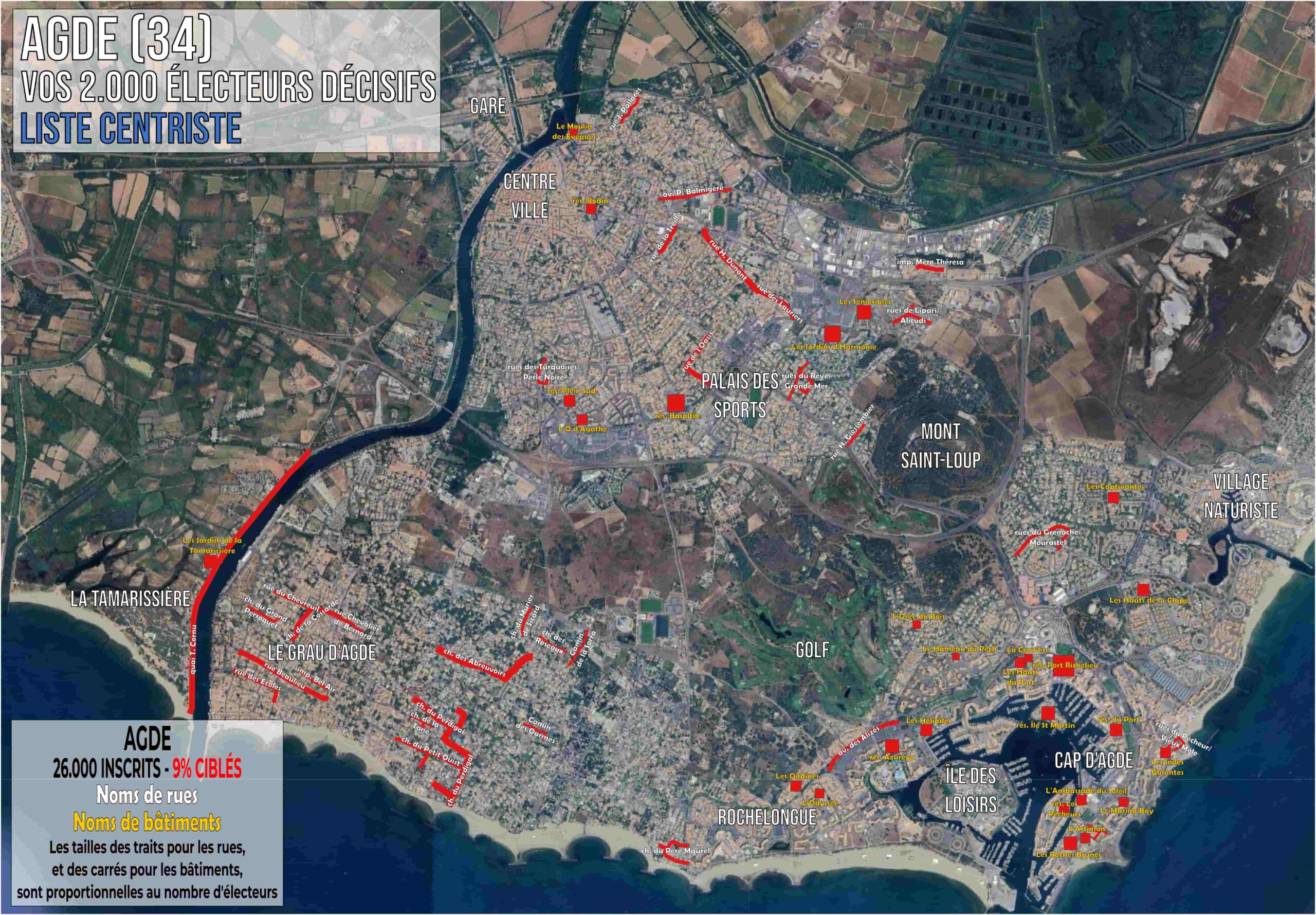
The size of the volunteer team depends on the size of the municipality or constituency, the time available before the election, and the targeted perimeter. As a general rule, a volunteer working in a pair (door-to-door canvassing is most commonly done in teams of two) can canvass effectively in two-hour shifts. During that time, they can make contact with an average of 10 people (voters or otherwise). In the context of a French municipal campaign, for example, I estimated that over the final two weeks of campaigning, a list in a town of 30,000 inhabitants fielding around forty candidates could, by mobilising two hours per day over five days per week, speak to and persuade approximately 2,000 voters. Well targeted, these voters are absolutely decisive in a candidate’s electoral result. This calculation adapts to any country and any scale of election — the key variable is always the ratio between available volunteer hours and the number of high-priority doors to knock. Below, an example from Agde in southern France.
What Are the Best Times and Slots for Door-to-Door Canvassing?
The best time slots are those when you have the highest probability of finding people at home. On weekdays: evenings if you are targeting working-age voters, daytime if you are targeting retirees. At weekends, it depends on local habits and volunteer availability. It is worth noting that door-to-door canvassing is received very differently across cultures: Americans are far more accustomed to it, Canadians and Quebecers are somewhere in between, while in Belgium, the Netherlands and parts of Northern Europe, voters can be relatively reluctant. In Southern Europe, India and many Commonwealth countries, cultural norms around unannounced visits also vary. Adapting to local expectations is part of running an effective canvassing operation.
How Do I Train Volunteers for Door-to-Door Canvassing?
An untrained volunteer team wastes its own time and the voters’. The minimum training covers three points. First, the introduction script: 30 seconds to introduce yourself, explain why you are there, and hand over the conversation to the voter. No political monologue — the goal is to listen. Second, the attitude: never get drawn into an argument, never directly criticise another candidate, always note feedback for the candidate (field intelligence is worth as much as votes won). Third, the materials: a short leaflet to leave systematically, a contact sheet to record each interaction (sympathiser, undecided, opposed, or absent), and a printed route map with the priority streets highlighted. Digital tools like Qomon or NationBuilder can digitise this recording, but a paper sheet is more than sufficient for medium-sized campaigns. Training takes two hours and should be repeated for each new wave of volunteers. It is an investment that transforms the productivity of the entire campaign.
Read more
→ Electoral Geomarketing: Definition, Methodology and Strategic Applications
→ FAQ n°2 — Voter Targeting in Election Campaigns
→ FAQ n°4 — Mobilising Non-Voters
DoorToDoorCanvassing #Haustürwahlkampf #HuisAanHuis #ElectionCampaign #ElectoralGeomarketing #VoterContact #Qomon #NationBuilder #NGPVAN #CanvassingStrategy #VolunteerTraining #StreetLevelTargeting #France #Belgium #Quebec #Netherlands #Germany #UK #India #Greece #Australia