

FAQ n°2 — Voter Targeting in Election Campaigns
Voter targeting in an election campaign means concentrating your time, budget and volunteer energy where every contact delivers the highest return. This FAQ answers the 7 essential questions on electoral targeting: how to identify undecided voters, how to prioritise neighbourhoods (quartiers, wijken, Stadtteile, wards, barrios, rioni), and how to move from blanket leafleting to an effective ground campaign — whether you are preparing for local, regional or national elections anywhere in the world.
Why Target Voters Rather Than Run a Uniform Campaign?
A uniform campaign distributes the same leaflet to every voter, organises door-to-door canvassing (porte-à-porte, huis-aan-huis, Haustürwahlkampf, doorstep campaigning) at random and places rallies without any territorial logic. This is the dominant approach in most countries, and it is also the least effective. Voter targeting, by contrast, means differentiating your campaign effort by polling station (precinct, ward, stembureau, Wahlbezirk), by neighbourhood, by street and even by building, based on the electoral potential of each. Three reasons make voter targeting essential: campaign resources (volunteer time, leafleting budget, rally slots) are always limited; not all voters carry the same weight in a victory (one undecided voter in a swing precinct is worth a hundred safe votes in a stronghold); and the marginal return of direct contact varies enormously depending on the profile of the voter reached. A well-run targeted campaign can produce the same result as a uniform campaign with two to three times fewer resources. This logic applies equally to a candidate in French départementales 2028, Belgian gemeenteraadsverkiezingen 2030, Quebec provincial elections 2026, German Kommunalwahlen, Dutch gemeenteraadsverkiezingen, British council elections, Indian state elections, Greek dimotikes ekloges or Australian local government elections.
How Do I Identify Undecided Voters in My Municipality?
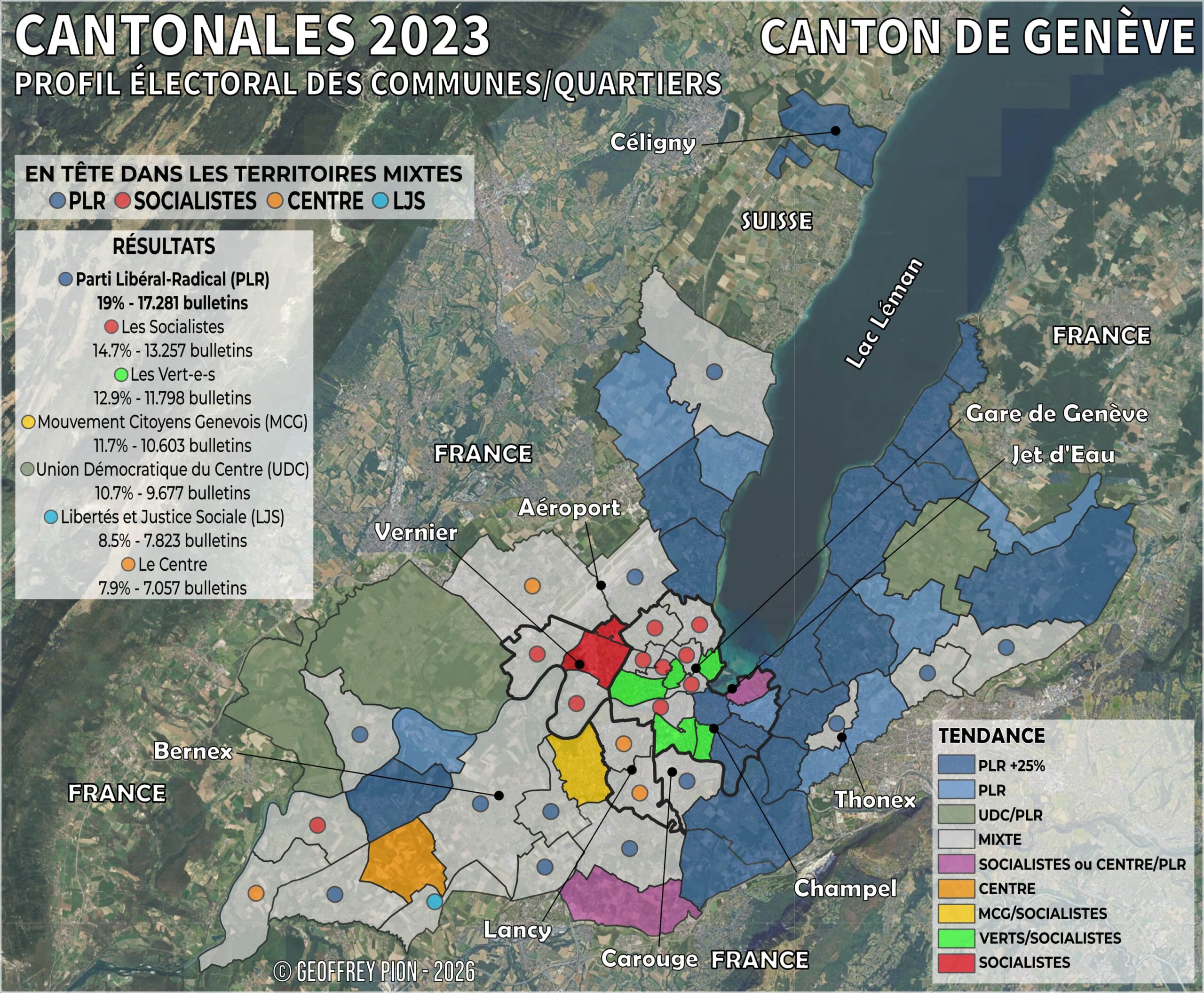
Undecided voters do not declare themselves as such and remain invisible in official voter files. They are identified indirectly, by cross-referencing several spatial indicators. The first is the analysis of polling stations where no candidate exceeds 30% of the vote in the previous election: these precincts statistically concentrate more voters hesitating between several political options. The second is electoral volatility between two comparable elections: precincts that change their dominant colour from one election to the next concentrate mobile voters. The third is the comparison between local and national elections: precincts that vote differently depending on the type of election reveal voters who are sensitive to the personality of candidates rather than to party labels. In the Canton of Geneva, for example, the electoral system, the very low quorum and the wide range of parties mean that many neighbourhoods and communes (gemeenten, Gemeinden) produce extremely dispersed results (shown in grey on the map below).
How Do I Prioritise Which Neighbourhoods to Target?
Prioritising which neighbourhoods to target rests on a trade-off between three variables: the electoral potential of the neighbourhood (number of convertible voters), the probability of tipping (gap between candidates at the previous election), and mobilisation potential (room for turnout growth). Sound targeting excludes two types of areas: safe strongholds (where every hour of door-knocking produces few additional votes) and lost-cause zones (where the return is even lower). The priority target is the intermediate neighbourhoods, where campaign investment can swing several hundred votes. This logic is universal: it applies to a candidate for burgemeester in Liège, Belgium, as much as to a candidate for the Chamber of Deputies in Luxembourg, a councillor candidate in Manchester, a Bürgermeister candidate in a German Gemeinde, a panchayat candidate in India, or a candidate for dimotiko symvoulio in Greece. A well-constructed prioritisation map visually ranks neighbourhoods across several levels of priority, from absolute priority to secondary.
What Is the Difference Between Targeting by Polling Station, by Street or by Building?
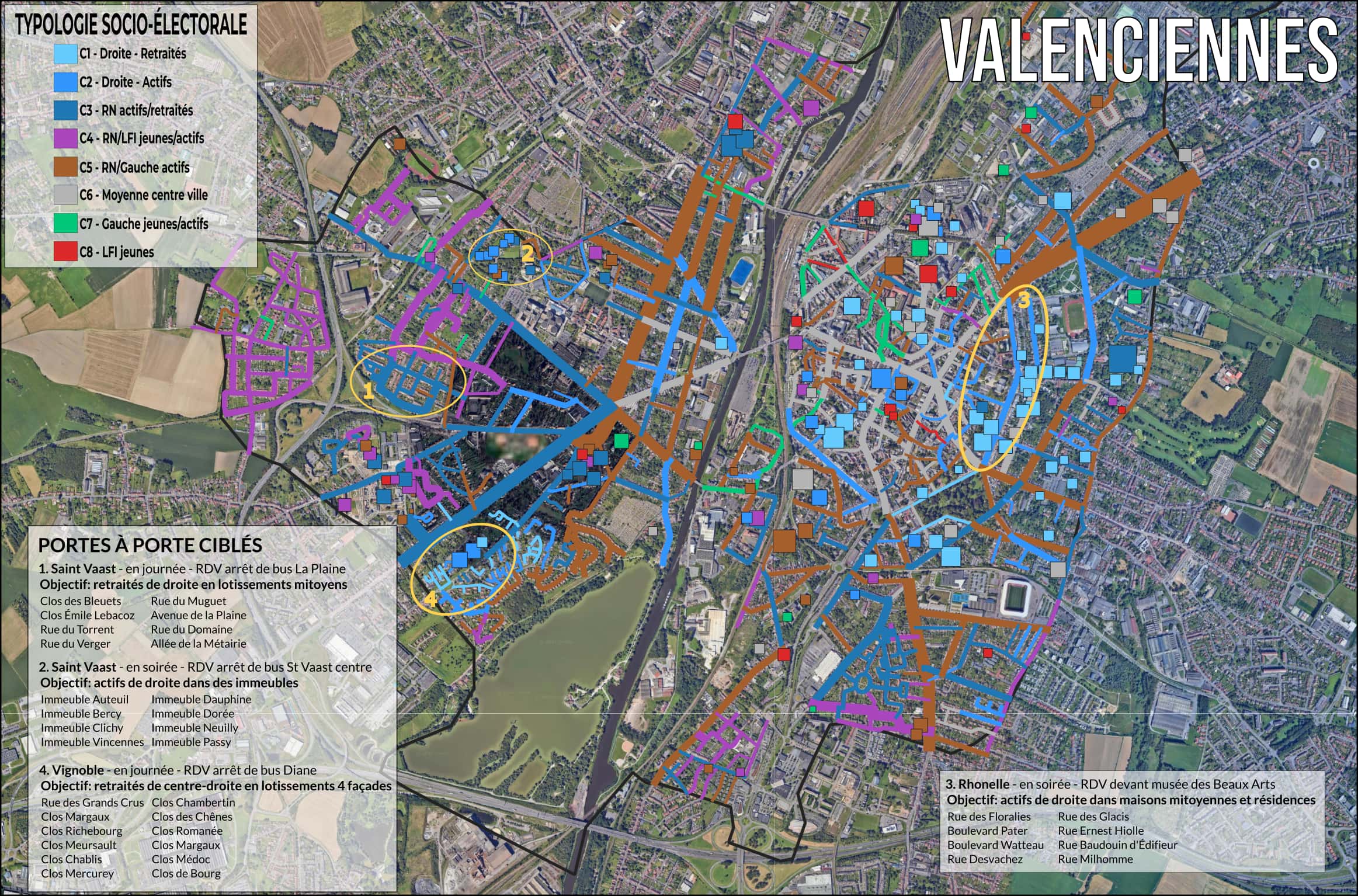
The polling station (precinct, ward, stembureau, Wahlbezirk, eklogiko tmima, polling place) is the baseline scale for voter targeting, publicly accessible in many countries (though not in Belgium, Luxembourg or Switzerland at sub-municipal level). But this scale aggregates several hundred to a thousand voters, which masks significant heterogeneity within a single precinct: a street of suburban houses (lotissement, verkaveling, Siedlung) may sit alongside a social housing estate (cité sociale, council estate, sociale woonwijk, Plattenbau) within the same polling station. To go further, you must descend to the street level, by cross-referencing polling-station results with the electoral register and official address databases. And to go further still, to the building level, using cadastral or property address databases. This street-and-building-level modelling, unprecedented in most countries, radically transforms how a campaign is run: you no longer leaflet an entire municipality, you no longer target a precinct — you target precisely the streets, the housing estates, the city blocks (îlots, huizenblokken, Häuserblöcke) and the buildings with the highest potential. This is the central challenge of modern electoral geomarketing.
How Do I Target Voters Differently in Apartment Blocks Versus Suburban Housing?
Voters in apartment blocks (logement collectif, flatgebouwen, Mehrfamilienhäuser, council estates, pisos) and voters in suburban detached housing (lotissement pavillonnaire, verkaveling, Einfamilienhaussiedlung, semi-detached suburbs) cannot be targeted with the same methods or the same campaign themes. In apartment blocks, the main challenge is gaining access to the building: a volunteer who gets through the entrance door of an 80-unit block can reach 80 households in two hours. The difficulty is the intercom, the entry code, the concierge. In suburban housing, the challenge is the time required: a neighbourhood of 200 detached houses demands extensive walking, and voters are less available during the day. In terms of messaging, concerns often differ: safety, public transport and education for urban apartment-block voters; local taxes, mobility and proximity of public services for suburban homeowners. This differentiation applies as much in Brussels as in Montreal, in Dakar as in Abidjan, in Lyon as in Lausanne, in London as in Mumbai, in Amsterdam as in Athens.
How Do I Use Previous Election Results to Target My Campaign?
Previous election results are the raw material of your targeting. They must be analysed at several levels. First, identify the polling stations where your political family achieved its best scores: these are your strongholds, to be mobilised without wasting persuasion energy. Next, identify the precincts where the gap with the winner was less than 5 or 10 points: these are your priority conversion targets. Then, spot the precincts with high abstention rates: these are your priority mobilisation targets. Finally, compare these results with previous comparable elections to identify underlying dynamics (rise or decline) by neighbourhood, ward or polling station. This analysis applies to all types of elections and all countries, and depends on the candidate’s political positioning, electoral track record and the interplay of local and national dynamics.
What Tools Can I Use for Voter Targeting?
The tools of voter targeting combine open data, cartographic software and methodological expertise. The data: election results by polling station (data.gouv.fr in France, elections.fgov.be in Belgium, Élections Québec, Swiss cantonal chancelleries, elections.public.lu in Luxembourg, the Kiesraad in the Netherlands, the Bundeswahlleiter in Germany, the Electoral Commission in the UK, the Election Commission of India, the AEC in Australia, the Greek Ministry of the Interior). The electoral register (accessible to candidates in many jurisdictions). National address databases. The software: QGIS for professional cartography (free, open source, the global standard), Excel or LibreOffice Calc for raw data processing, and statistical modelling tools for fine-grained analysis. The expertise: this is the critical factor. Having the data and the software is not enough — you need to know how to build relevant spatial models, choose the right explanatory variables, and produce readable maps for candidates who are not geographers. This is the role of the electoral cartographer, still very rare in most countries, which represents both a difficulty for candidates and an opportunity for those who master these skills.
Electoral Geomarketing: Take Action
Are you a candidate in an upcoming election anywhere in the world? Here are some key electoral milestones where voter targeting can make the difference:
Country | Election | Year
France | Presidential & Legislative | 2027
Latvia | Legislative | 2026
Belgium | Federal & Regional | 2029
Quebec | Provincial (general) | 2026
Quebec | Federal (Canada) | 2029
New Zealand | Legislative | 2026
Taiwan | Local | 2026
Australia | Federal | 2028
Greece | Legislative | 2027
Germany | Legislative | 2029
India | Federal | 2028
Spain | General | 2027
Sweden | General | 2026
Finland | Legislative | 2027
Italy | Municipal | 2026
Malaysia | Federal | 2028
Read more
→ Electoral Geomarketing: Definition, Methodology and Strategic Applications
→ FAQ n°1 — Understanding Election Results in Your Territory
→ FAQ n°3 — Organising Effective Door-to-Door Canvassing
VoterTargeting #ElectionCampaign #SwingPrecinct #DoorToDoorCanvassing #ElectoralGeomarketing #PollingStationAnalysis #CampaignStrategy #PoliticalMarketing #ElectoralMapping #MicroTargeting #France #Belgium #Quebec #Switzerland #Netherlands #Germany #UK #India #Greece #Australia