

FAQ n°1 — Understanding Election Results in Your Territory
How do I view election results by polling station in my country? Where can I find an electoral map of my municipality? How do I read results precinct by precinct? This FAQ answers the 7 essential questions for understanding the fine-grained electoral geography of your municipality, constituency or ward, and making the most of officially published data — wherever you are in the world.
How Do I View Election Results by Polling Station, Precinct or Ward?
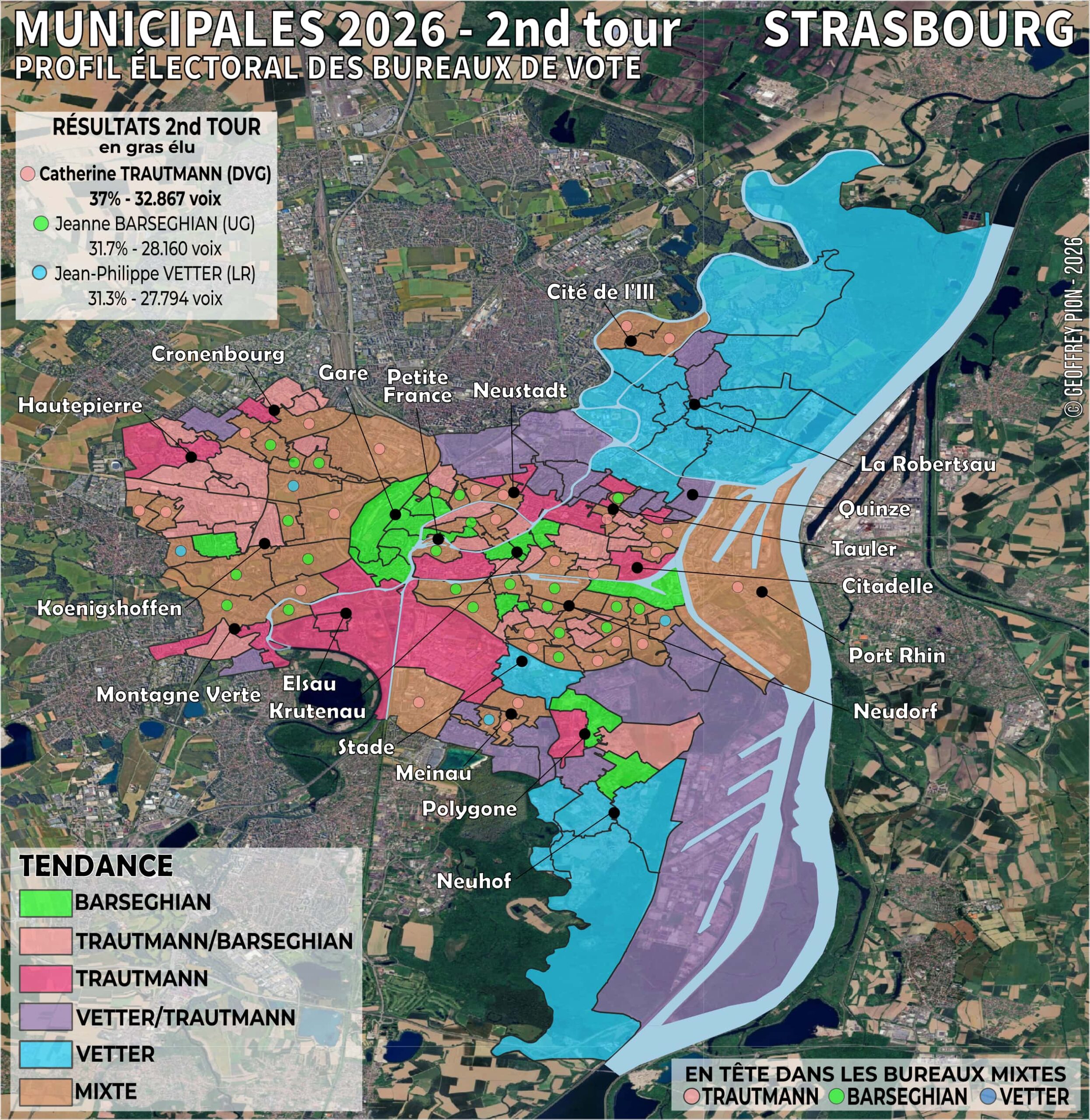
Access to election results at the polling station level varies from country to country. In France, the Ministry of the Interior publishes results on data.gouv.fr a few days after each election (presidential, legislative, municipal, departmental, regional, European), in CSV format by département. In Belgium, the SPF Interior publishes results by polling station (stembureau) for federal, regional and municipal elections via elections.fgov.be. In Quebec, Élections Québec publishes results by polling division (section de vote) for provincial elections. In Switzerland, results by polling station are published by cantonal chancelleries, with formats varying widely between cantons. In the Netherlands, the Kiesraad publishes results by stembureau for all national and provincial elections. In the United Kingdom, results are available by ward through local authority websites and the Electoral Commission. In Germany, the Bundeswahlleiter and Landeswahlleiter publish results by Wahlbezirk. In India, the Election Commission publishes results by polling station for state and general elections. In Australia, the AEC publishes results by polling place for federal elections. In Greece, results are available by eklogiko tmima through the Ministry of the Interior. In all cases, these raw files in CSV or Excel format remain difficult to use without processing: to actually visualise results by polling station on a map, you need to cross-reference the data with a cartographic base layer showing the boundaries of each polling station or ward. This is precisely what electoral geomarketing produces — transforming unwieldy spreadsheets into readable maps, neighbourhood by neighbourhood (quartier, wijk, Stadtteil, barrio, rione). See the example below from Strasbourg:
Where Can I Find an Electoral Map of My Town?
No official website, in any country, publishes an electoral map by polling station for municipalities. Local authorities — French mairies, Belgian gemeentebesturen, Quebec municipalities, Swiss Gemeinden, Dutch gemeenten, British councils, German Stadtverwaltungen, Greek dimoi — generally hold an internal boundary map delineating polling stations or wards, used for voter notification, but this map is almost never shared publicly or cross-referenced with election results. Regional press occasionally publishes maps the day after an election, but these remain rare and limited to major cities. To obtain a detailed electoral map of your municipality, you must either request the cartographic boundary file from your local authority, or engage an electoral cartographer who masters GIS tools such as QGIS and can work with national datasets. Electoral geomarketing consists precisely in producing these otherwise unavailable maps for candidates, elected officials and the press, at scales ranging from the polling station (precinct, ward) down to the street and the building.
How Do I Read Election Results Precinct by Precinct?
Reading results precinct by precinct means analysing how each candidate or list performs across the different neighbourhoods (quartiers, wijken, Stadtteile, barrios, wards) of a municipality, rather than relying solely on the overall score. Three readings are essential, and they apply in every democratic country. First, the absolute score of each candidate in each polling station, which reveals their strongholds and weak spots. Second, the balance of power between the leading candidates station by station, which shows where the decisive gaps lie. Third, differential turnout, which highlights the precincts where mobilisation could swing the result. A well-constructed polling-station map visually translates these three dimensions through a colour code that distinguishes homogeneous strongholds, swing zones and under-mobilised territories. It is this spatial reading that transforms a table of numbers into a strategic campaign tool — whether you are preparing for French legislative elections, Belgian gemeenteraadsverkiezingen, a Quebec municipal election, German Kommunalwahlen, Dutch provinciale verkiezingen, Indian state elections, British council elections, Greek dimotikes ekloges or Australian local government elections.
What Is the Finest Scale for Analysing Election Results?
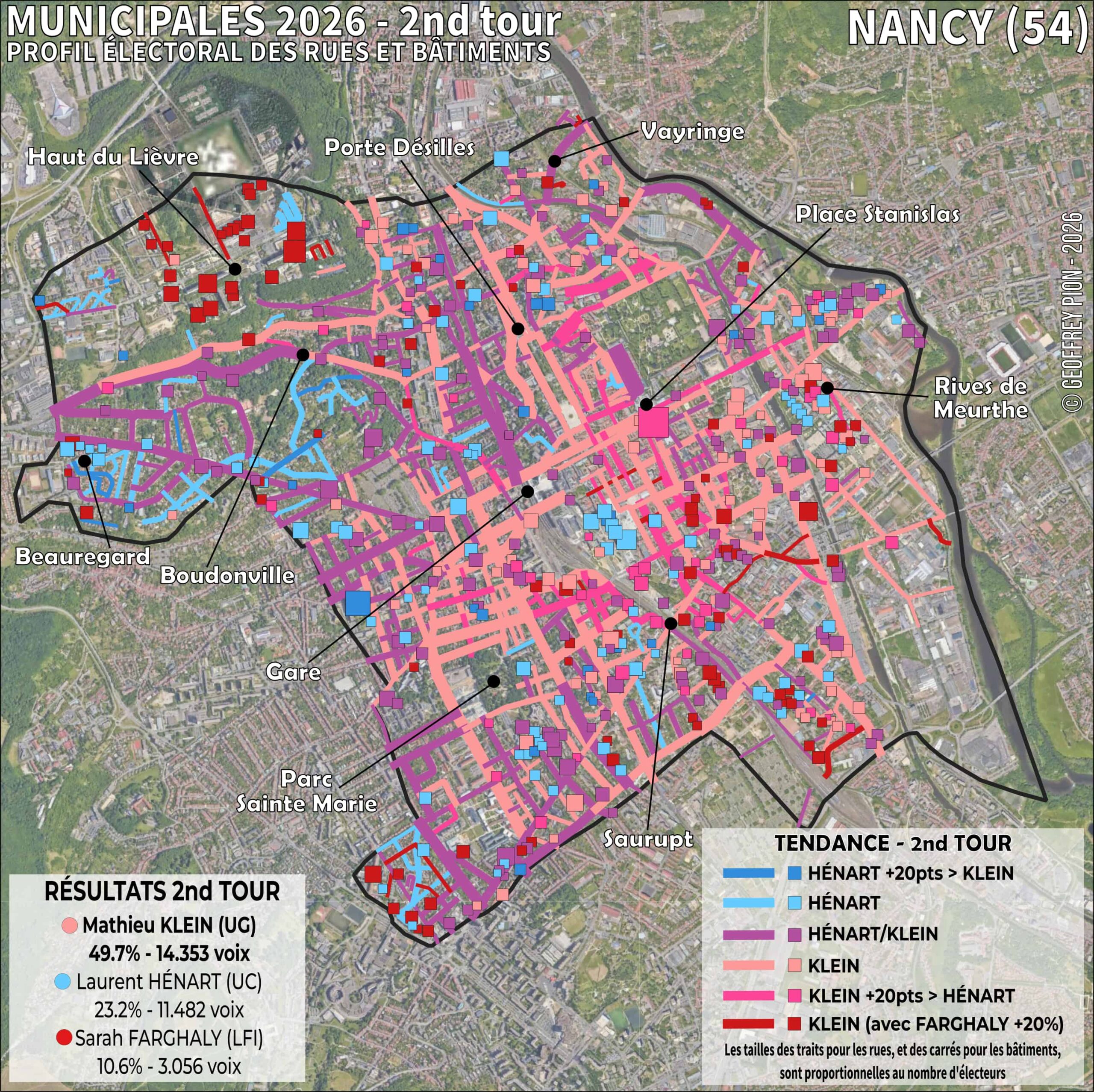
The finest officially published scale is the polling station (bureau de vote in France, section de vote in Quebec, stembureau in the Netherlands and Belgium, Wahlbezirk in Germany, polling place in Australia, eklogiko tmima in Greece), which typically covers several hundred to a thousand registered voters depending on the country and the municipality. This is the benchmark scale for any serious electoral analysis — far more informative than the municipality as a whole (too broad for medium and large towns) or the constituency, province or canton (too heterogeneous). But it is possible to go further: by cross-referencing polling-station results with the electoral register and official address databases, one can model voting behaviour at the scale of the street, the housing estate (lotissement, verkaveling, Siedlung), the city block (îlot, huizenblok, Häuserblock) and even the individual building. This approach, unprecedented in most countries, has been developed to produce ultra-fine maps of French municipalities, and remains transferable to Belgian, Quebec, Swiss, Luxembourg, Dutch, German or British municipalities wherever address files are available. It opens new possibilities for precise voter targeting during campaigns. Below is an example of a street-and-building-level electoral map from Nancy (Lorraine, France).
Why Do Results Vary So Much from One Polling Station to Another Within the Same Town?
The gaps between polling stations within a single municipality reflect the sociological, demographic and urban differences between neighbourhoods. A polling station in a social housing estate (grands ensembles, council estate, sociale woningen, Plattenbau) does not vote the same way as one in the town centre or one in a suburban area of detached houses (lotissement pavillonnaire, vinex-wijk, Einfamilienhaussiedlung). This pattern is universal and holds in Lille as in Liège, in Montreal as in Geneva, in Amsterdam as in Athens, in Mumbai as in Melbourne. The main explanatory variables are the socio-professional composition of residents, their education level, average age, housing tenure (renters versus owners), the presence of social housing, and more broadly the electoral history of the neighbourhood. The gaps can be dramatic: it is not uncommon for the same candidate to score 15% in one precinct and 50% in another within the same municipality. It is precisely this internal heterogeneity that makes electoral geomarketing valuable: it reveals geographies that are invisible at the scale of municipal averages.
How Do I Identify the Swing Precincts in My Municipality?
A swing precinct (swing poll, bureau de vote pivot) is a polling station where no candidate dominates clearly and where a few dozen votes separate the leading contenders. To identify them, look for a tight gap between the top two or three candidates — less than 10 percentage points. Swing precincts are a priority target for any rational election campaign, whether you are fighting a French legislative race in 2027, Belgian gemeenteraadsverkiezingen in 2030, a Quebec municipal election in 2029, a Swiss cantonal election, Dutch gemeenteraadsverkiezingen, German Kommunalwahlen, Indian state elections, British council elections or Greek dimotikes ekloges: this is where door-to-door canvassing (porte-à-porte, huis-aan-huis, Haustürwahlkampf, doorstep campaigning), leafleting and mobilisation actions deliver the highest return on effort. A well-constructed polling-station map immediately highlights these high-stakes precincts, visually distinguishing them from safe strongholds and lost-cause areas.
How Do I Use a Polling-Station Map in a Municipal Campaign?
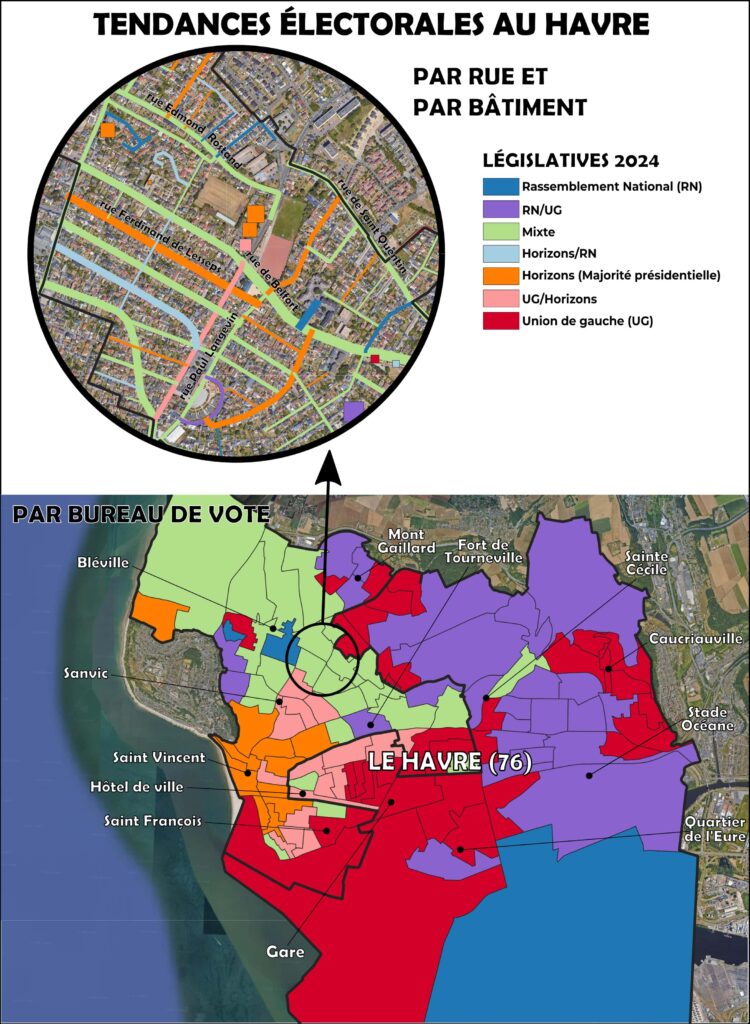
A polling-station map is not a decorative object: it is an operational campaign tool, useful for any candidate in any country. It serves several concrete purposes. First, prioritising the neighbourhoods and precincts with the highest stakes to focus door-knocking (canvassing, démarchage, huis-aan-huisbezoek, Haustürwahlkampf, doorstep campaigning) and leafleting. Second, spotting low-turnout precincts where mobilisation can make the difference. Third, adapting messaging and campaign themes by neighbourhood based on the sociological profile of each precinct. Fourth, calibrating rallies, letterbox drops and pop-up offices according to the real geography of the electorate. To go beyond the polling-station level, it is possible to descend to the scale of the street, the housing estate (lotissement, wijk, Siedlung), the city block and the building through spatial modelling: this is what electoral geomarketing delivers, at an accessible cost even for medium-sized municipalities.
Electoral Geomarketing: Take Action
Are you a candidate in a local, regional or national election — anywhere in the world? Are you an elected official or a journalist seeking to better understand the electoral geography of your territory? A polling-station map of your municipality (or a street-and-building-level map) can be produced at rates adapted to the size of your territory. Whether you are running in French municipales, Belgian gemeenteraadsverkiezingen, Dutch gemeenteraadsverkiezingen, German Kommunalwahlen, Swiss elections, Quebec provinciales, Indian state elections, British council elections, Greek dimotikes ekloges, Australian local government elections, or any other democratic election — the methodology adapts to your context.
To learn more about the method, read the full definition of electoral geomarketing:
→ Electoral Geomarketing: Definition, Methodology and Strategic Applications
→ FAQ n°2 — Voter Targeting in Election Campaigns
→ FAQ n°3 — Organising Effective Door-to-Door Canvassing
ElectoralGeomarketing #ElectoralMapping #PollingStationResults #PrecinctAnalysis #WardMap #ElectionResults #FAQ #VoterTargeting #SwingPrecinct #DoorToDoorCanvassing #PoliticalMarketing #ElectoralCartography #CampaignStrategy #France #Belgium #Quebec #Switzerland #Netherlands #Germany #UK #India #Greece #Australia