

Electoral marketing refers to all the techniques a candidate or party uses to win votes. This FAQ answers the 7 essential questions to understand what these two terms cover, identify the components that actually win an election (and those that win none), and place electoral geomarketing as one of the most effective dimensions of contemporary political marketing, whether you are preparing a U.S. congressional race, a U.K. constituency campaign, a Canadian provincial election or a French legislative race.
What is the difference between electoral marketing and political marketing?
In practice, electoral marketing and political marketing are largely synonymous. Both terms refer to the application of marketing techniques to the conquest and management of political power: electoral market research, voter segmentation, candidate positioning, message targeting and outcome measurement. A theoretical distinction does exist: political marketing covers ongoing political communication (between elections, for parties and elected officials in office), while electoral marketing focuses on campaign periods.
What are the components of electoral marketing?
An electoral campaign is a sandwich made of several ingredients, none of which is sufficient on its own. First, the international and national context: every election takes place in a period more or less favorable to a party, a theme, a vision of society, and the candidate must adapt to it. Second, the local context: characteristics of the constituency, the local mood, local issues that crystallize public opinion. Third, the candidate, their image and their personal style. Fourth, the platform and campaign themes. Fifth, communication, both in the media and through public appearances or social networks. Sixth, fieldwork (leafleting, postering, mailbox drops, door-knocking). Seventh, polling, now technically and financially accessible at local scales. Electoral marketing consists in orchestrating these seven components coherently, concentrating resources on those that produce the most votes.
Does the national context really weigh on a local campaign?
The national context is the first determinant of a campaign, including local ones, and the candidate has no control over it. In the 2026 French municipal elections, the dominant campaign theme was security. The Rassemblement National positioned its main proposal on insecurity, and all other candidates had to position themselves in relation to that demand. Those who chose to bet on trust, citizen participation or programmatic debate without integrating the security question were generally the major losers of the vote. The same dynamic plays out everywhere: in the 2024 U.S. presidential election, immigration and inflation framed the entire race, and Democratic candidates who tried to run on other themes paid the price. Electoral marketing means reading the context lucidly, without illusion, and adjusting one’s positioning. The local context then reinforces or tempers the national context: it is weaker, but it can be decisive when a specific issue mobilizes voters (zoning, transit, public facilities).
Does the platform actually win votes?
Very few. This is probably the most counter-intuitive conclusion of contemporary political marketing, but it is solidly established: the vast majority of voters do not read platforms. The rational voter who compares all platforms and chooses in good conscience is a Western fantasy, almost nonexistent in reality. In the 2026 French municipal elections, left-wing lists almost systematically presented the most solid platforms, the most competent teams, the most realistic proposals, and held the most numerous policy meetings. Except where local sociology was very favorable to them, their results were extremely weak relative to the time invested. This is the very antithesis of electoral marketing: a clear slogan beats a 30-page platform. The platform remains necessary to govern once elected, but it wins almost no votes during the campaign itself.
What is the role of communication and field work in political marketing?
Communication includes public appearances (markets, rallies, local and regional media, televised debates) and direct communication via social networks, which now allows candidates to stage themselves and reach their electorate without intermediaries. But the historical core of Western electoral marketing is the four pillars of field communication: leafleting, postering, mailbox drops and door-knocking. Postering bonds an existing team of activists but has very little impact on the vote itself. Market leafleting is the cliché of grassroots militancy, even though markets are now frequented only by a narrow and aging segment of the electorate. Mailbox drops are widely used but rarely effective at convincing voters: it is baseline activism, a way of saying you were on the ground. Door-knocking, which everyone talks about but few candidates and campaign teams actually practice, is scientifically the most effective channel in the world (see our FAQ on door-to-door canvassing). In Quebec and across North America, door-knocking is culturally embedded in the candidate’s job: an aspiring nominee is expected to have « worked the riding » for years before claiming to represent a party. It is even said that several parties now require their potential candidates to provide proof of several thousand doors knocked before they can even run for the nomination.
What is the role of polling in a campaign?
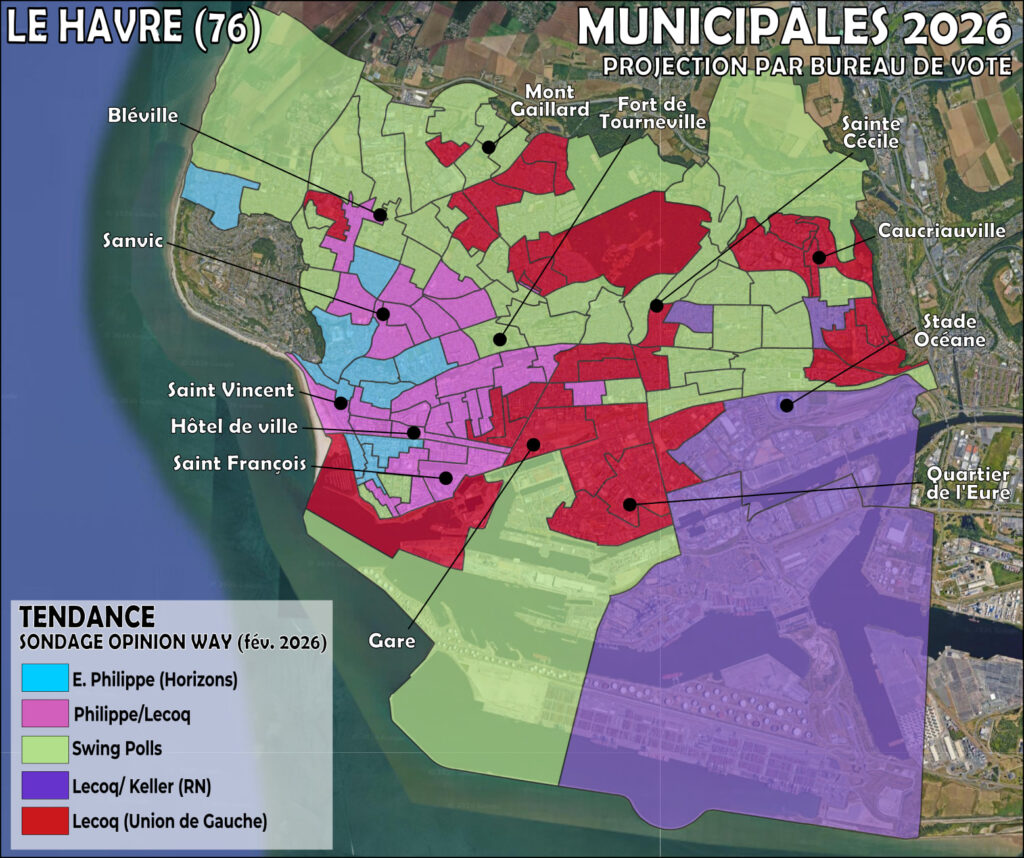
Polling was once reserved for national campaigns and very large cities. That era is over. A candidate in a town of 50,000 inhabitants, or at the scale of a legislative constituency, can now finance a local poll and measure their name recognition, voting intentions, the social characteristics of their electorate, the image voters have of them, the themes they are associated with and the dominant concerns of their voters. Combined with electoral geomarketing, polls become a formidable targeting tool that crosses the social, spatial, programmatic and communicational dimensions of a campaign. It is one of the major shifts in electoral marketing of the past twenty years.
Where does electoral geomarketing fit within all of this?
Electoral geomarketing is the spatial dimension of political marketing. It does not replace any of the previous components: it irrigates them and makes them infinitely more effective. A good reading of the local context relies on a geographic analysis of voting behavior. A good field communication strategy (leafleting, mailbox drops, door-knocking) relies on spatial targeting: which streets, which buildings, which polling stations to prioritize. A good use of polls relies on cross-referencing them with sub-municipal geographic data. Electoral geomarketing is therefore not the most important component of electoral marketing, but it is probably the one that produces the best cost-per-vote-won ratio. Reaching 2,000 targeted voters door-to-door at the campaign’s momentum, rather than canvassing at random, is the difference between a strategic campaign and a guesswork campaign. This is what I offer to candidates and elected officials in the French-speaking world and across the rest of the planet.
To go further in political marketing:
→ How to target voters in an electoral campaign?
→ How to organize an effective door-to-door canvass in an electoral campaign?
→ How to mobilize abstainers in a local election?
Electoral marketing: take action
Geoffrey Pion, electoral geomarketing consultant, works with candidates and elected officials worldwide.
📱 +33 6 49 28 20 81
Hashtags:
#ElectoralMarketing #PoliticalMarketing #ElectoralGeomarketing #ElectionCampaign #CampaignStrategy #VoterTargeting #DoorKnocking #Polling #France #Belgium #canada #australia #india #FAQ